Research session seminar series

On weekdays during the research sesion, seminars will take place every morning from 9h30 to 10h30 in the main auditorium (A1). 

Schedule for the first week: 

Monday July 20
9h30 - 10h: Oscar Eduardo Reyes - From Physical Climate Risk to Capital Allocation: Modeling the Transmission Chain, with an Application to Droughts
10h - 10h30: Carlos Manuel Orrego Franco - ALLO: An Adaptive Landslide Learning Observatory for Uncertainty-Aware Climate-Risk Monitoring

Tuesday July 21
9h30-10h30: Stéphane Crepey - The impact of financial intermediation in carbon markets

Wednesday July 22
9h30 - 10h: Lihong Guo - Renormalization group method for fractional noise driven systems
10h - 10h30: Jacob Kellermann - Signature Kernel Ridge Regression

Thursday July 23
9h30 - 10h30: Mathieu Laurière - TBC

Friday July 24
9h30 - 10h: Yuqiong Wang - Play it longer when it matters: optimal match lengths in knock-out tournaments
10h - 10h30: Jialu Ding - Phase Transitions in Competitive Lotka–Volterra Ecosystems on Sparse Random Graphs: A Cavity Method Approach

Course materials

Mini-courses

Freddy Bouchet: download link

Mathieu Barbier: lecture 1lecture 2lecture 3

Olivier Lopez: download link

Simon Scheidegger: download link

Claire Monteleoni: Day 1Day 2

Special invited lectures: 

Roxana Dumitrescu: download link

Jan Polcher: download link

René Aïd: download link

Luc Doyen: download link

Free-time activities during CEMRACS

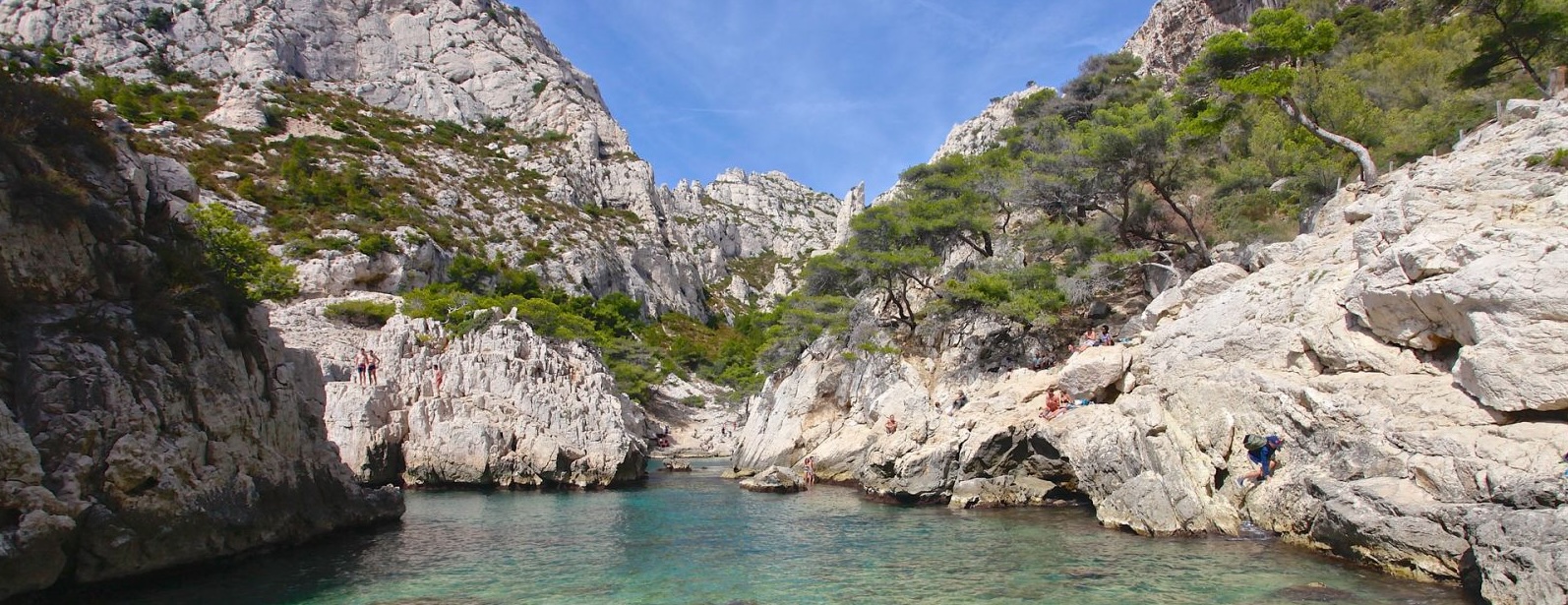
By Olena Ilnytska - Own work, CC BY-SA 4.0, https://commons.wikimedia.org/w/index.php?curid=72182244

During CEMRACS, participants are encouraged to explore Marseille, its coastline, and its cultural heritage. The purpose of this page is to help participants make the most of their time in Marseille, meet other attendees, and enjoy the city at their own pace. Below are suggestions for visits and activities that can be organized individually, as well as ways to connect informally with other participants.

Enjoy your stay !

Organized activities

During the week-ends of the research session, two organized outings will take place. The registration instructions will be given to all participants in due course. 

  • Boat trip from Cassis to the Calanques on August 9
  • Hiking trip to Sainte-Baume natural regional park (TBC)

Access to the Calanques

The Calanques National Park is a protected natural area. During summer, access rules vary daily due to fire risk and environmental protection. Some areas may be freely accessible, restricted, or closed.

Note that the Calanque de Sugiton requires a free mandatory reservation during the high‑season period. Reservations open three days before the visit at 9:00 AM and are automatically cancelled if the site is closed due to fire risk.

Official information and reservation link: https://troov.com/parc-national-des-calanques/rendez-vous

Staying safe in the Calanques:

  1. Check fire risk and access restrictions before going
  2. Wear hiking shoes, avoid hottest hours, carry enough water and cover your head
  3. Tell someone where you are going and stay on marked trails

Suggested visits and activities

  • Château d’If: A short boat ride from the Vieux-Port leads to the historic fortress known from The Count of Monte Cristo, with remarkable views over the bay.
  • Frioul Islands: Clear waters, easy walking paths, and a peaceful atmosphere just minutes from the city.
  • MUCEM: The Museum of European and Mediterranean Civilizations offers major exhibitions, contemporary architecture, and direct access to Fort Saint-Jean.
  • MAC – Musée d’Art Contemporain: Located near the Prado, appreciated by participants who enjoy modern art.
  • Musée Cantini: In the city center.
  • Cosquer Méditerranée: An immersive reconstruction of the prehistoric underwater cave, located inside the Villa Méditerranée.
  • Tourist Train & Notre-Dame de la Garde: A convenient way to reach Marseille’s iconic basilica and enjoy a panoramic view over the city.
  • Vallon des Auffes: Small traditional fishing port near the Corniche, very atmospheric and easy to reach by bus.
  • Parc Borély & Plage du Prado: Large landscaped park followed by a walk along the Prado beaches.
  • Corniche Kennedy coastal walk: Beautiful seaside promenade with viewpoints, benches, and access to small coves.
  • Fort Saint‑Nicolas & Pharo Gardens: A pleasant area overlooking the Vieux-Port. The Pharo gardens offer wide lawns and panoramic views
  • Cité Radieuse (Le Corbusier): Architectural landmark located very close to Luminy. The rooftop terrace is accessible and offers a unique view of the city. Interesting for participants who enjoy architecture and modern design.
  • Parc de la Magalone: A lesser-known classical garden on the south side of Marseille.
  • Vieux-Port to Vallon de l’Oriol walk: A gentle urban walk along the waterfront, passing through lively neighborhoods and ending near the Corniche.
  • Col de Sugiton (without descending into the calanque): A short hike from Luminy leading to a spectacular viewpoint over the sea and the calanques. No reservation needed if you stay on the upper path.
  • Col de Morgiou: Another easy hike starting from Luminy, offering views over Morgiou and Sormiou.

Staying safe in Marseille:

Marseille is a large Mediterranean city with real crime problems. The main tourist risk remains theft, but participants should still avoid situations and areas where violence is more likely and follow common-sense rules:

  1. Keep phones and bags secure, avoid displaying laptops or expensive items.
  2. During the day, central/coastal areas, public transport, and all sights listed above are generally safe, but it is not recommended to visit the northern parts of the city; 
  3. At night, stay in busy, well-lit central or coastal areas; avoid isolated streets, empty station surroundings, parks, beaches, and unfamiliar neighbourhoods. 
  4. Late at night, take a taxi/VTC rather than public transport to return to CIRM.
  5. Be especially alert around Saint-Charles station, Noailles, La Canebière, the Vieux-Port, and crowded public transport, where theft and uncomfortable encounters are more likely.

Connecting with other participants

Participants are welcome to create informal discussion groups (WhatsApp, Signal, etc.) to organize spontaneous activities such as:

  • City walks or seaside strolls
  • Morning or evening jogging
  • Swimming outings
  • Football matches
  • Cultural visits
  • Informal gatherings

These groups make it easy to share quick invitations (e.g., “Jogging at 7 pm — anyone interested” or “Visit to the MUCEM on Saturday”).

Modeling and AI for environmental transition

Announcement

This event will gather scientists from academic and industrial communities to discuss and work on the modeling and AI for environmental transition

The program includes:

  • 1-week summer school (July 13-17)

  • 5-week research stay, working on projects proposed by academic scientists or industrial partners (July 20 - August 21)

The event takes place at CIRM (Centre International de Rencontres Mathématiques) in Marseille (France). 

Participants can register for the summer school or apply for the research stay funding (the number of on-site participants is limited). 

Registration

Please use the menu in the upper left corner to register for the summer school. To apply for the research session, please first register for the summer school, then complete the research session application through the link which will appear in the menu, and finally choose at least 3 research projects on which you would like to work through another link which will appear. Accepted research session participants must attend the summer school (registration fees are waived in this case) and stay for the entire 5-week period. Unless a special arrangement has been reached, meals and on-site accommodation will be provided to accepted research session participants free of charge; no funding is provided for travel costs. 

Topics

The urgency and complexity of the climate crisis call for contributions from many scientific domains, and the modelling challenges posed by the environmental transition call for inter- and transdisciplinary approaches, based on a multitude of data sources. At the same time, recent developments in climate science, climate economics, ecology, and other sciences dealing with environmental transition require stronger interactions of these disciplines with applied mathematics and data science to develop new models for simulating realistic scenarios, making predictions, and anticipating and controling risks. 

The CEMRACS 2026 will be an interdisciplinary event, focused on mathematical, statistical, financial, actuarial, and economic  modeling for the environmental transition, with a specific focus on the following domains:

  • Environmental and climate economics
  • Climate change adaptation and mitigation
  • Insurance and reinsurance
  • Energy economics and finance
  • Green finance, climate-related physical and transition risks
  • Ecology, biodiversity dynamics, agriculture, fisheries
  • Water management
  • Climate science

Committees

Contact

In case of questions / problems, or if you want to propose a project for the research stay, please contact the organizers at cemracs26@smai.emath.fr